

Once Upon a Mind
Once Upon a Mind (2021-1-IS01-KA220-VET-000034877) is a project co-funded by the European Commission, focusing on young people’s health.
In today’s fast-changing world, mental health of young people has become a critical issue, as the onset of mental illness peaks in adolescence and early adulthood: 50% of mental disorders develop before the age of 15 and 75% by the age of 25. This has significant consequences for individuals, their families and communities, as well as for the local, national and global economy, which is why the European Youth Strategy includes improving the mental well-being of young people as one of its objectives. The project aims to create an educational package of innovative tools, methods and practices for educators, youth workers, entrepreneurs and individuals to apply and use in their daily and professional lives to combat/prevent mental health problems.
The project will produce these products:
1. An informative booklet: a comprehensive publication covering 12 key topics on different aspects of young people’s mental health and well-being, from self-reflection to creative expression and physical activity.
2. An activity booklet: a set of preventive and restorative activities that can be done in groups to raise awareness, acquire competences, skills and knowledge, initiate mental hygiene development and improve mental health.
3. Instructional videos: these are a simple way of engaging and raising awareness among young people, building on the content of the information booklet.
4. A board game: an educational board game that raises awareness of common mental health problems, their symptoms and prevention, to educate young people.
CT4Silver – Certified training for elderly carers
CT4SilverCaregivers (Silvercare) is a European project under the Erasmus+ vocational training programme, which aims to promote the employability and mobility of elderly care workers by developing their personal, professional and social skills.
The CT4SilverCaregivers (Silvercare) is a European project in the framework of the Erasmus+ programme for Vocational Training, which aims to promote the employability and mobility of care workers in the elderly care sector by developing their personal, professional and social skills.
The project aims to promote the employability and mobility of workers through the development of their personal, professional and social skills.
The project will raise awareness on care and provide training for health professionals, non-specialist care workers and all those who wish to work in the care and health sector in the European Union on active and healthy ageing, highlighting the importance and challenges of this issue. To achieve this, the European partners will develop innovative training modules to be tested with the project’s target audience and create user communities on the project platform.
The European partners of the CT4SilverCaregivers project are the Zamora Regional Council (the lead partner) and the University of Almeria from Spain, the Association for the Management of European Funds – AGFE from France, the Dafni Training and Research Centre from Greece, and TREBAG Ltd. from Hungary, a company specialising in education and training, from Ireland the Association of Rural Centres for Training and Local Development and from Portugal the Castelo Branco Polytechnic Institute.
MENTA50+ Learning to take actions for mental fitness and wellbeing in older age
MENTA project undertakes to respond to these challenges by providing guidelines and concrete training material on mental fitness for people 50+ and providers by:
- raising awareness for the importance of mental fitness and wellbeing
- giving guidelines on how to promote them
- developing innovative learning material
The main outcomes of the project are (in 6 languages)
- Manual with theory and practical exercises on mental fitness and related fields (nutrition, stress management, physical fitness, social networks)
- Online material with IT based serious games
- Model course curriculum for blended course on mental fitness
To ensure high quality, the involvement of target group and success of dissemination the project will:
- investigate the field and collect good practices
- set up advisory boards of experts, providers and seniors
- organize a mobility for exchanging information
- develop materials (manual,online tool,model course)
- test project outcomes in a pilot phase
- address older people in a “Be active-mind your mind” day
- final conference
TIME-WELL Trainers to Improve their Knowledge of Medical Wellness in Adjoining Fields of Service

How can you adapt results gained in the field of wellness sector to other adjoining fields? What the hell is Nordic Walking? What modules on motion can we inbuild to the traditional subject methodologies? You can find answers to these questions and more in the materials of Time-well project.
The project undertook to develop new training materials in the area of wellness including motion and healthy nutrition for students in vocational education, based on previous Time-well materials. In Hungary in the framework of the programme students had the chance to get introduced to nordic walking by professional trainers. Students wishing to be employed in the future in hotel industry and in tourism , could get useful information about various forms of healthy and active lifestyle. This knowledge can be really useful when applied in their future carreer.
Mindwellness: Improving learning capacities and mental health of elder people
Is it possible to train our minds? Can we improve learning capacities over the age of 50? Our MINDWELLNESS training material tells you all. The project aimed to develop an online training material with modules on factors affecting mental flexibility and capacity in older people. The material is also accompanied by interactive games aiming to improve mental fitness via serious games online. A Grundtvig multilateral project initiated by Trebag.
Fill in our online test! You can check how mentally fit you are.
You can improve your mental fitness in a playful way.
To maintain your mental fitness it is not enough to play games, but also you will have to change your lifestyle by considering several factors
Start now. Improve your mental fitness and change your lifestyle. Let the games and the new lifestyle become part of your everydays!
Contact us if you need any help.
Related material in the Knowledge Centre:Keeping Fit in Later Life, which primarily improves physical fitness of the ageing.
Naturesport – Motivating Adults – Sports in Nature
The aim of the project Adult motivation with Nature Sport was to increase life motivation of people 35+ be either employed, unemployed, or retired, with outdoor sports.
With the help of this project we aim to enhance the knowledge of both the participants and the trainers, in order to raise the level of their quality of life. For the sake of this we developed new strategies and training material for adults; also organised and supported already existing sport events.
In Hungary we developed training materials on outdoor sports with theoretical background as well as practical information. In close cooperation with the local sports association Crosskovacsi SKE we introduced a parent-children bike race adjoining to their annual mountain bike event.
HEB-VET Health Education and Behaviour in Vocational Education and Training
Dear Reader,
This brochure of best practices and activities was developed within a Leonardo da Vinci Learning Partnership, with partners (see 5) from Czech Republic (Stredni odborna skola), Italy (Il Piccolo Principe), Germany (IBB Dresden and ABU gGmbH Berlin), Finland (HT Metka Oy), Spain (CEMFE), United Kingdom (Newham College) and Hungary (TREBAG). Its main purpose was to provide a collection of activities which support health conscious behaviour in vocational and educational training.
We hope you can benefit from our experiences and would love to hear from you should you be interested in knowing more or simply telling us about your ideas regarding the HEB-VET project!
projekt homepage: https://sites.google.com/site/hebvet11/home
TREBAG Ltd participated on the Health day of nagykovácsi in 2011, introducing the project aims and goals by different games, quizzes and nordic walking trial. A teaser video of that day can be reached through the link below:
http://www.youtube.com/watch?v=e0T006CNnvA
Good Health!
European countries face the situation that populations are getting older. Demographic statistics show that there will soon be a lack of young employees in the labour market. Labour market requirements are rising and so do requirements for the physical and mental fitness and vitality of employees.
Health is one of the most important indicators for a successful integration into the labour market. State of health has more influence on opportunities in the labour market than formal qualifications. So the significant importance of state of health is very clear.
Analyses of state of health of young people in European countries show a rising number of health problems. Diseases which are typically found in older people already appear in young trainees and employees. Smoking, binge drinking, drug consumption, nutritional disturbance and lack of physical exercise cause problems in their working life. In addition to the high cost for social and health insurance systems, young people reduce their employability and so their chances in the labour market.
Young people need motivation and knowledge on how to practise a healthy lifestyle to ensure, keep and extend employability. For that reason existing experiences were exchanged, different approaches were compared and good practice identified.
Not only should health education take place in training programmes, but also integration of healthy behaviour and motivation for dealing with these themes in the lifelong learning process. Health supporting public discussions, events and education in VET should work as an initial point for further lifelong learning processes.
The partnership analysed national situations regarding state of the art of implementation of health education and health supporting content in normal everyday life at vocational training centres, schools and in training programmes. Together partners compared different situations and developed suggestions and recommendations for management, teachers and trainers on how to involve holistic health support in organisations and in training programmes.
The different national traditions, approaches and situations enriched the working process and results of the Leonardo da Vinci partnership and thereby helped to improve the European cooperation between organisations and schools providing VET. The joint development of suggestions and recommendations was characterised by involvement of national approaches and will provide a European additional benefit for all partners and associates. These suggestions and recommendations are provided in this guidebook and on the project website so that they can be used in VET in different European countries.
Some partners were able to organise joint events which had a greater impact on all participants – staff and learners. Comments from participants were confirmation of the need for inclusion of healthier lifestyle options which were greatly appreciated and effective.
Health education begins during the time of general education in primary and secondary schools and tends to be overlooked when young people change to vocational education and training. They do not think about the link between their lifestyle, their chances in the labour market and their employability. Interviews in participating countries showed that themes of health, health awareness, healthy behaviour and health support are not, or hardly, included in normal everyday life at school and in training programmes. Comparisons of different VET programmes show that physical education and sports are included in education and training programmes on very different levels. Too little health education, motivation for a better lifestyle and more physical and mental vitality takes place. There are exceptions in some professions eg personal services such as nurses, cosmeticians, child educators and some others, but health education takes place in a quite formal way. Young people are not empowered to adapt this knowledge for their own life, their behaviour and for a healthy lifestyle. In other professional training programmes such as craft, commerce and industry there is only a little content included. These existing approaches could be used to develop suggestions for school managers, teachers, trainers and students to open up their organisation and training programmes for health supporting discussions, events and education.
The project aimed to compare situations in participating organisations and countries. The partnership developed suggestions and recommendations for integration of health education in normal everyday life at school, in training and education to inform and motivate young people to lead a more active lifestyle. Holistic comprehension of health, their own contribution to a more active lifestyle, to take on responsibility, and the change from health awareness to healthy behaviour was
the focus of the project.
The partners worked on three thematic levels:
1. Healthy nutrition
2. Motion and fitness
3. Prevention of addiction.
Project partners searched for ways of how to implement these themes into participating schools and organisations considering age, professional orientation and social background of learners. Together they identified good practice which was presented on the website, in videos and in this guidebook for teachers.
To motivate participating organisations, trainers and learners the partnership organised kick-off “Fit for the Job – Day of Health” in all participating countries. Project partners invited social partners and local providers of health supporting offers such as health insurances, sport studios etc to involve them in the agenda of the day. This day gave a good example of how to implement health education into everyday life at school and in training programmes.
Over the course of the project partners gained experience in planning and performing a “Fit for the Job – Day of Health” in their own organisations. Best methods to motivate young people to live a more active lifestyle and healthy behaviour were monitored and presented in videos and a guidebook for teachers. To organise partnership work six partners hosted a transnational meeting in which existing approaches were presented and the exchange of information, experiences and knowledge organised. During the transnational meetings the partners had discussions with health experts and local partners. Practical application of learned skills will help trainers and teachers to achieve competences in health education and healthy behaviour.
The partnership also aimed to contribute to the development of social and self-management competences in European vocational training. Trainers and teachers can improve their multi- disciplinary competences; connection between VET and the demands of the labour market regarding longer employability and healthier staff could be consolidated. Results and outcomes of the project can support trainers, teachers, young learners and employees to open their minds for European dimensions of VET and European Mobility. Thus, the project was able to contribute to a key item of European education policy, to the discussion of quality and effective use of human competences for more effective employability and employment.
3.1.
It is well documented that healthy nutrition is very important for our lives. However, only a few people practice it and they are mainly adults who have fallen ill or sports people. Young people are not interested in a healthy diet and prefer meals and drinks that are eaten and drunk quickly by their own age-group. They have sufficient information about healthy nutrition from school lessons and public press but they perceive it as a theory. Therefore we decided to introduce healthy nutrition in a less formal way. The following activities a re described fully in the best practices section.
Our health science teacher suggested to students that they could prepare some small healthy meals and bring them to the classrooms where other students could taste them. The teacher explained why those meals were suitable for health and how they affected the digestive system and whole body as well. All participants were surprised how tasty the meals were. Recipes of all the meals were printed and exchanged among interested people. This way the students were encouraged to cook for their families, siblings and friends. They were able to use their theoretical knowledge to prepare a really healthy meal and they also learned that healthy meals can be prepared easily and inexpensively as well.
There is a class in our school that organises a Snack Day once a week. These students make and bring healthy snacks and share them. Examples of healthy cooking were various vegetable and fruit salads, kinds of spread /cheese, fish, meat, kinds of canapé, vegetarian pizza, simple pasta, cottage cheese desserts, etc.
Healthy nutrition in VET programmes
Our second activity related to our aim of healthy nutrition was a Day of Health that was held in February 2012. Students were informed about the programme on a school notice board in advance. The programme included a lecture by a nutrition specialist who spoke about the impact of healthy and unhealthy nutrition on the human body. After that they split into groups according to their interests and took part in many different activities related to healthy lifestyle. Our students appreciated this special day at school and suggested organising similar events more often.
We have learned how important it is to inform and encourage young people to eat and live healthily. These young people will influence the next generation to eat properly and lead more active lives.
3.2.
Promoting a healthy lifestyle and giving motivation to young people to take care of their fitness and lead an active life is an ever challenging task of our society. Although in most countries the issue is dealt with at the highest strategic levels, and there are continuous efforts to include it in national curriculums, attention is often distracted from motion and fitness towards more cognitive-oriented subjects. However, the importance of physical exercises, motion and in general a positive attitude to a healthy lifestyle is scientifically proven to have major effects on the overall well-being of people. Directly, in the long run, the lack of adequate physical exercise can lead to several illnesses and reduced performance. Indirectly, it can have a negative effect on many factors of life including performance in the workplace, mental capability, mood, etc. Special focus should be paid to younger generations, as their whole attitude towards an active and healthy lifestyle can depend on the impulses gained at this early stage.
There could be several ways to include motion and fitness into VET education:
1. Include it as a separate unit into the subjects taught at the institution. Obviously, this has limits as to the official national curriculum, the local curriculum, human
resources etc.
2. Include the topic of motion and fitness in a more hidden way into the thematics of other subjects. Expand the quantity of motion by applying methods such as “learning by doing” for example or just raising awareness about the importance of motion.
3. Having it as an extra-curricular activity either on a regular or just occasional basis. This can include campaigns on different sports or try-out classes where youngsters can experience the benefit of an exercise directly.
Trebag, in cooperation with the local vocational school, implemented the third version. The local vocational school is a branch school of Piliscsaba Agriculture and Forestry Vocational School, where students between the ages of 14-18 learn various professions. These include, for example, tourism and catering. We addressed students of tourism as for them understanding and pursuing a healthy lifestyle is not only generally important but also can be very closely related to their actual profession.
Nowadays active tourism has become a popular trend and employees in the sector have to train themselves to know about various ways of active pastimes to be able to recommend to clients different activities as well as be able to plan programmes, venues etc accordingly. To be updated, and thus have better chances in the labour market, young students need to have an overall view on opportunities. As Nordic Walking is a very effective and also easily realisable sport, its knowledge is essential for students of tourism. Therefore, with a trained trainer we organised an intensive course for the students and their teachers where they could acquire the basics of Nordic Walking and also could learn about its benefits and potential use in their future sectorial environments. The course was successful
and as a result was transferred to other target groups too, and finally Trebag elaborated an educational video about the basic steps for Nordic Walking.
What is Nordic Walking? Nordic Walking has been developed from northern ski running. It was used as supplementary training when there was no snow, and then, from the beginning of the 90s, it developed into a separate sport. Its main advantage is that it moves the whole body, thus the joints and muscles of the legs, the upper torso and the posteriors as well. It is very popular especially in Northern countries, Germany and Austria, but has been spread all over the world now.
There are no national campaigns in Slovenia dealing with the health of tourism employees. However, a project coordinated by the Slovenian Tourist Board (STB), the main national tourist organisation in Slovenia, can be used as example.
STB’s mission is to plan and perform the promotional activities of Slovenia as a tourist destination and to position Slovenia as a clearly and easily recognisable country. The latter is the key to success in the extremely competitive tourism market. In order to achieve this STB has set a goal to promote Slovenia as a green, active and healthy country. All the activities of recent years tie in with the I FEEL SLOVENIA brand and support the idea of SLOVENIA GREEN.
STB believes that a clean environment and unspoilt nature are competitive advantages which are a condition both for the sustainable development of tourism in a country and for maintaining a quality way of life for its inhabitants. STB decided to introduce environmental management measures and standards in their offices in the hope of encouraging Slovenia’s (tourism) industry and destinations towards the development of green tourism. One of the measures introduced includes care for the well-being of STB’s employees, since their self-health awareness and environmental consciousness will influence both their productivity and work efficiency on the one hand and their perception and communication of the Slovenia Green idea on the other.
The Slovenia-Friendly Office project
Given that we spend more than a third of the day in the workplace we should be aware that sometimes even our everyday office activities can have a negative impact on the environment, along with certain bad habits that have crept into our everyday routine. STB has decided to introduce some new elements and measures into their office activities to help reduce negative impacts on the environment, nature and people.
The “greening” of the offices takes place as part of the Slovenia Friendly Office – SLOVENIA GREEN project that was devised with external help. The project focuses on the following indicators:
– waste and material flow,
– energy consumption,
– water,
– transport,
– well-being.
The main aim of the project is to reduce negative impacts on the environment, nature and consequently (local) inhabitants. On the one hand energy-saving measures and operations were introduced through which operating costs are reduced, on the other hand an eco-team of employees was formed. Its goal is to
increase the level of environmental education among STB’s employees and as such set an example for the entire public administration, the business sector and households. STB believes that only environmentally aware employees can protect the environment and also their own health and well-being.
Well-being of employees
Special care was paid to employees, their well-being in the work environment and their health in general. Ergonomics was employed to fulfil the goals of health and productivity. Eco-team was formed to take care of the measures, such as:
– functional office equipment (including position of table, light)
– electronic equipment (quality of material used, eco- material) ergonomic equipment (chairs, tables) health advice (quality of office air, how to sit, what to wear that is comfortable, healthy nutrition, movement).
– Employees were encouraged to use public transport, walk or cycle instead of coming to work and/or going to meetings by car. Bus tickets were purchased and available to all who needed to exit the building during work hours and attend a meeting in Ljubljana. Additionally, one bicycle was purchased and made available to all 30 employees.
Motivating people, especially the younger generation, can be a difficult task at times. This is not because these young people are considered lazy, but a healthy lifestyle at their age is not so much a priority. Therefore programmes and activities organised to raise their interest and knowledge in a healthy lifestyle have to catch their attention in some way. Just listening to lectures about how to eat healthily and joining general and boring P.E. will just not do the trick. These activities have to be really interesting, avoiding the general information about how healthy fruits are and how unhealthy sweets can be because everyone knows it already. It is not a secret. Our task was, and still is, to create events and activities where vocational school students can enjoy themselves and gather knowledge through interesting activities.
During the project the partners planned and implemented different kind of activities. There were both serious and joyful events with different approaches, focusing on healthy food or physical exercises and even some on mental health. The aim was common: to draw the students’ attention on how important their health really is and how this will affect their later life either regarding work or family.
The slightly different characteristics of the project partners secured that the best practice activities would be varied, and they were. During the 2 years of the project all partners held at least one health day, organised bilateral programmes with each other, and shared the ideas and experiences, ensuring that the final guidebook and DVD is a valuable product.
During the project we received feedback on the activities we carried out. Most of them could be considered a success, both on expertise and pleasure side. The participating students learned about the importance of taking care of their health during their younger years, and could give and receive information and useful skills on the topic, as some of the students are involved in health education as part of their studies. Participating organisations became enthusiastic in exploring ways of incorporating the activities into their learning programmes.
As a final conclusion we can acknowledge that the project all in all was a success, both for the learning partnership and the project products.
Heb-Vet has been a wide network of European institutions which have shared their experiences on how healthy lifestyles can improve the achievements of students involved in vocational and educational training. The main results have been the celebration of the ‘Day of health’ at each organisation and the shooting of a video showing the activities carried out. There were also some unexpected results, such as the ‘healthy games’, which can be easily transferred and also could be the starting point for future co-operation agreements.
Partner organisations are happy with the involvement of teachers and students in this project. Many of them took an active part at the transnational meetings held throughout the last two years. Students learned how physical exercise or healthy food habits can improve their lifestyles and some of them reported actual changes in their daily behaviour.
Co-operation between partners and the European added value given to each organisation have been the most valued items by the partners. Managing such a huge partnership is not always easy and communication barriers were overcome with a special effort by those teachers, trainees and delegates who were not fluent in English. This has been an extra learning experience for them.
KIFLI- Keeping Fit in Later Life
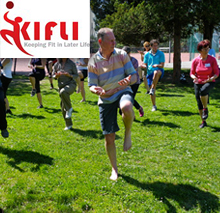
Keeping Fit in Later Life- KIFLI provides an online interactive training material for people 50+ to gain knowledge and guidance on how to improve their physical activity and fitness. It is a project but also a programme offering various opportunities to practice exercises, to try new ways and to get motivated. Grundtvig Multilateral project initiated by Trebag Hungary.
SAGE+- Senior citizens participate in creating their lives
The project focused on the development of a training for “participation facilitators” for social planning of the elderly. The target group of the pilot training was interested people 50+ who received a practice-oriented training to be prepared for their work. The beneficials were also the elderly themselves. A Leonardo Pilot project.
This project has been funded with support from the European Commission.
This publication [communication] reflects the views only of the author, and the Commission cannot be held responsible for any use which may be made of the information contained therein.

The project was funded by the European Commission. The views expressed in this publication (Communication) do not necessarily reflect those of the European Commission.


