

Green-On project

Project number: 2023-1-PL01-KA220-VET-000157945
Project name: Green-On – Cooperation partnerships in vocational education and training
The GreenOn project aims to help business leaders make the green transition. We offer a free, comprehensive training package that provides insights into key theoretical concepts, regulations, and the psychological and interpersonal factors that influence employee engagement. Components:
Handbook – A theoretical summary for company managers. It is supplemented by a glossary, best practices, exercises, micro-videos per chapter. Topics include: leadership and change management, eco-innovation and digital transformation, green HR management, circular economy and green office concept. The handbook also covers eco-psychology, sustainable communication and corporate social responsibility.
Online self-assessment tool – Available from the project website, it can be used repeatedly at individual and company level. Questions can be answered using the Likert scale. The tool assesses the current success of the green transition based on the scores achieved and provides feedback with suggestions for further improvement. When completed again, it also shows what progress has been made and to what extent.
Offline card game – The set includes the game description, attractive-looking cards. The game models the practical implementation of the green transition, allowing you to practice strategy building in a playful way. During the game, the participants collaborate and discuss opinions, which can strengthen the corporate team spirit.
Eco-coaching workshops – a methodological guide for running 5 workshops. These group sessions can strengthen the commitment of company employees to the green transition and increase team cohesion.
Further information: https://greenonproject.eu/
Funded by the European Union. Views and opinions expressed are however those of the author(s) only and do not necessarily reflect those of the European Union or the European Education and Culture Executive Agency (EACEA). Neither the European Union nor EACEA can be held responsible for them.
The information material of the project can be downloaded in PDF format:
Proud – Professional aid 4 young workers facing diverse challenges at work

PROUD (2022-1-HU01-KA220-000086673) aims at reinforcing individual well-being and professional excellence of working youth. In order to achieve this goal, we will develop a complex mentor training material and it will have 3 parts:
1. Mentor’s Guide: a guide for mentors/trainers/HR of companies on professional skills development. This Guide contains theory and exercises adapted to Gen Z & Y needs.
2. Map of mental welfare in the workplace: an easy-to use diagnostic tool for mentors. This diagnostic tool will inform about the most common mental health problems in the workplace among youth, highlighting signs and triggers.
3. Mind-balance kit: this Mind-balance kit for Gen Y & Z employees is a material on sustainable and mindful self-management in a workbook style. Through the kit, young employees can learn practical tips and hands-on techniques (e.g. mindfulness, positive psychology, resilience, job crafting), and they will be encouraged to reflect on their work-life.
More information: www.proudproject.eu
Funded by the European Union. Views and opinions expressed are however those of the author(s) only and do not necessarily reflect those of the European Union or the European Education and Culture Executive Agency (EACEA). Neither the European Union nor EACEA can be held responsible for them.
ISPIRER

Inspirer project is a European Erasmus+ project aiming to promote, through innovative and integrated approaches, equality, and diversity in the workplace, for companies that employ both younger and older generations.
Inspirer provides companies, organisations, managers, and employees the necessary tools to eliminate age discrimination and segregation in the workplace and to create positive and inclusive working environments for older generations.
The consortium that gives the project services their expertise and validation is a multinational team, experienced in Human Resources and Training are.
EPIC
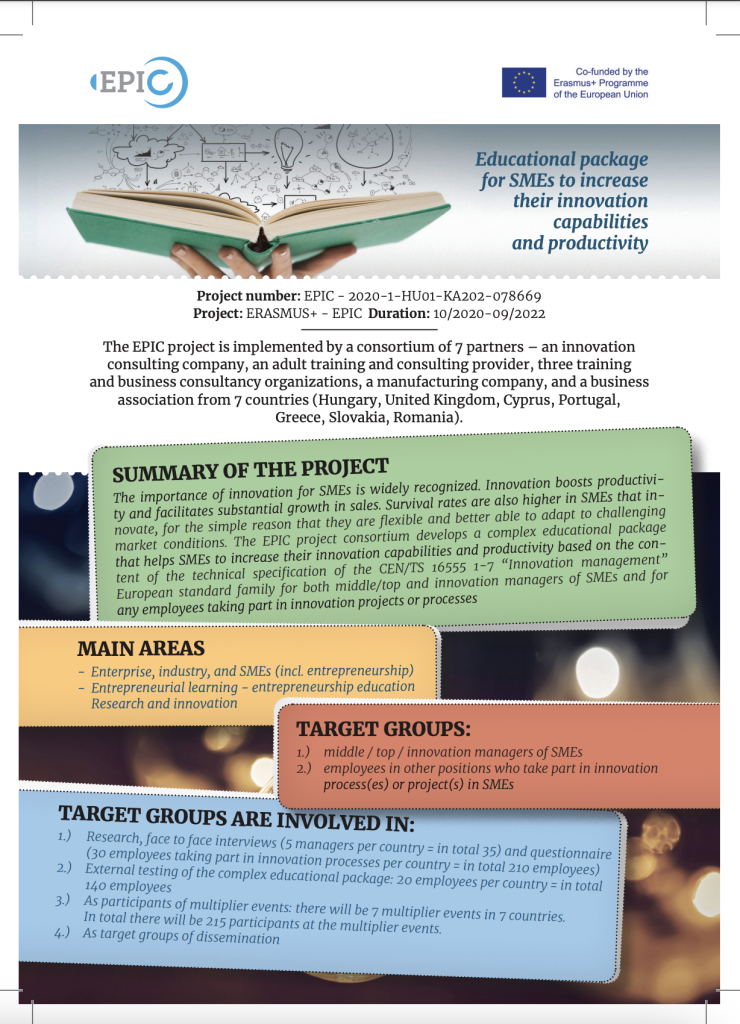
EPIC – Educational package for SMEs to increase their innovation capabilities and productivity (2020-1-HU01-KA202-078669)
Nowadays, in order for companies to be able to maintain their competitiveness in the market, it is essential to be innovative. But in general, managing innovation processes in one system is a greater challenge for small and medium-sized enterprises (SMEs) than for large companies.
Therefore, the EPIC project aim is to help SMEs to raise their awareness and to manage their innovation processes at a systemic level.
For this reason, self-assessment tools and a training material will be developed by an international consortium of 7 countries.
The partners of the international consortium: TREBAG Ltd. (Hungary), SPK (Slovakia), DEKAPLUS (Cyprus), ETA (United Kingdom), IDEC (Greece), Tabela (Portugal) and ENERGOM (Romania).
The main outputs of the project are the following:
1. Study of innovation management skills/competencies/knowledge
2. Online self-assessment tools
3. Training package
This project has been funded with support from the European Comission.
More information: https://epic-project.net/en/home/
Please find the informational publication of the project here.
Enter.M – Internship Model for developing Entrepreneurial skills to higher education students

As nowadays young people should be able to turn ideas into action, successfully develop new commercial and social ventures and be innovator in the organizations where they work the aim of EnterMode project is to stimulate entrepreneurial skills of higher education teaching staff and company staff and develop the entrepreneurial mind-set and related skills of higher education students. Its main objectives are:
- Raising awareness on the importance of internships for higher education students in general and for building entrepreneurial skills
- Developing HEIs–companies partnerships for the promotion of entrepreneurial education of higher education students
- Capacity building of higher education teaching staff and companies’ trainers, to organise entrepreneurial teaching and learning
- Developing entrepreneurial mind-set, skills and competences of higher education students, during their internships
- Developing an integrated model of entrepreneurship skills acquisition that includes different levels of learning, using online serious game
- Building a community of practice that allows for developing common practice and integrating newcomers into existing business communities
- Developing learning analytics to enable the tracking of learning progress and adapt the EnterMode program to personal and organisational needs.
Planned outputs:
- Background Study “Entrepreneurial education in HE in partners countries, entrepreneurial skills required by HE students, framework for internships”
- Internship model for acquisition of entrepreneurial skills by higher education students + Pilot experimentation
- Community of Practice
- Teachers’ guide on Internship model for acquisition of entrepreneurial skills by higher education students
- Serious game
- Development of HEIs – company partnerships
- Workshops for HEIs teachers and companies trainers
Project partners:
- Technical University of Kosice (SK)
- ASTRA (SK)
- Semmelweis Egyetem (HU)
- TREBAG (HU)
- Ludwig Maximilians Universitat München (DE) Praxis und Wissenschaft Project gmbh (DE) Universitá Telematica Pegaso (IT) EUROCREA Merchant (IT) University of Ioannina (GR) IDEC (GR) Association of SA & Ltd cos (GR) eucen (BE) Stichting Incubator (NL) CCS Digital Education (IE)
More information: https://entermode.eu/
More information for companies
INSOM

To keep up with modern technologies are the key for people to be successful in the labor market.
INSOM project gives an opportunity for the target group to self-improve their competences in online marketing and be able to get trained in this field.
The project focuses on the development of knowledge and competencies in the field of online marketing for small and medium enterprises through a developed online training material.
Project partners:
- CZU (CS)
- TREBAG (HU)
- XAMK (FI)
- SCAS (BG)
- UNICA (IT)
More information: www.insom.eu
English leaflet
Incrementa
INCREMENTA is a project for promoting an Innovation and Creativity mentality in SMEs and it aims to develop an educational method, in order to help SMEs rapidly react, adapt to changes and manage challenges.
According to Bloomberg, 2017, the pace of innovation and disruption is accelerating, as globalization has created an extremely competitive environment, where the faster pace of innovation is a critical to success. We are at in the era of a knowledge-based society, in which knowledge itself, incorporated in every product around us, is a fundamental element of competitiveness. If the EU wishes to retain its global position and to improve it against competition, it has to enhance creativity and innovation. This should be a conscious and persistent effort for SMEs, relying on training and learning rather than merely on luck and coincidence. Additionally, Collaboration management is also an imperative need for SMEs, as they are often isolated.
THE MAIN SCOPE OF INCREMENTA:
- promote the implementation of an Innovation Management System in SMEs
- develop basic and transversal skills using innovative methods
- promote creativity and collaboration in SMEs
- help SMEs successfully rapidly react, adapt to changes and manage challenges
- familiarize SMEs with the Standard CEN 16555-5 Innovation Management
- provide training material based on the Standard CEN 16555-5 Innovation Management – Part 5 and -Part 6, regarding creativity and collaboration in SMEs
- contribute to the professional development of VET, and VET teachers/trainers
- facilitate the adaptation of SMEs & VETs to the modern economic situation
EXPECTED MAIN RESULTS OF INCREMENTA:
- The Innovation Management System Guidebook for SMEs with Creativity and Collaboration Management contents that support the IMS implementation based on CEN/ TS 16555-6 – Part 6 and Part 5. (Including a Health Check of Creativity and Collaboration Management in SMEs with questionnaires.)
- A training program for Creativity and Innovation Management System in SMEs in the framework of an overall Innovation Management System.
- An online platform for SMEs’ innovation, that consists of Collaboration board games, Innovation Thinking decision tree and Innovation Management mini games.
TransIT

In today’s fast changing world, the digital transformation brought new brand challenges into the work environment as well. The labour market is constantly transforming and demands new competences. In these dynamically developing and uncertain circumstances managers have key role, they are the ones who have to coordinate the adaptation to Industry 4.0 in a sustainable way, by preparing and leading their organizations and their people into the new era. Their knowledge and competences will play a strategic role.
The objective of the project is to create a concentrated work-based training kit for the middle management of SMEs with a technical background, which aims at developing transversal competences necessary for managing the transition to Industry 4.0, in work environment. Innovative thinking and motivational management are the key training units that overarching and involve further modules/other competences. From these, businesses may select „packages” according to their needs. Our goal is to enhance innovation and motivation, as key elements of success: maximising the ability to bring out the best of the workforce, inspiring to innovate and optimising the use of HR The objective of the project is to create a concentrated work based training kit for the middle management of SMEs with a technical background, which aims at developing transversal competences necessary for managing the transition to Industry 4.0, in work environment.
TransIT is composed by 8 institutions from 6 countries (Hungary, Ireland, Slovenia, Portugal, Bulgaria and Greece) from different fields – university, manufacturing company, chamber of commerce, training and consulting companies from the fields of innovation/behaviour analysis/Industry 4.0
Newsletters
A projekt pilot képzésen megtartott előadások az Ipar4.0 és a mesterséges intelligenciával kapcsolatban.
A júniusi konferenciánk legérdekesebb előadása humán erőforrás fejlesztés és az ipar4.0 elvárásai tükrében.
Intranet – Intrapreneurship net-playbook

Partners:
The Intra net project (Intrapreneurship net playbook) is Erasmus+ KA 2 project that had its beginning in November 2018 and will end in October 2020 and attempts to promote the intrapreneurship skills and competencies, by mixing business, educational institutions and individuals. This allows the construction of highly effective dynamic teams and collaborative groups that make possible the transfer and valorisation of knowledge, the organisations’ continuous innovation and competitiveness increase Individuals should acquire new attitudes and skills in non formal and informal way (digital society, globalisation, continuous changes and risks, etc.
To sum up, Intranet is intended to promote intrapreneurship through educational processes by means of the creation of activities that could be further applied in organisations to increase their staff and skills.
- Centre for the Innovation and Development of Education and Technology (Spain)
- Jan Dlugosz University in Czestochowa (Poland)
- Gospodarska Zbornica Slovenije Center Za Poslovno Usposabljanje (Slovenia)
- Stichting Project Realisatievan Initiatievendoor Modulatievan Entrepreneurschap (Netherlands)
- Trebag Intellectual Property– and Project Manager LTD (Hungary)
Website: http://intra-net.org/
Coop-In project – Social Innovation Training for Virtual Work Based Learning
Due to changes in the economic environment, demographic change and greater socio-cultural diversity, businesses and organisations are facing a number of challenges and opportunities in effectively managing their day-to-day operations and strategic direction and development. For example, demographic change is leading to greater age diversity within the workforce of the majority of businesses, where there are now the needs and values of three or four different generations of people to manage. Similarly, socio-cultural diversity is increasing with the greater movement of people. In turn, this creates a set of different learning and skills development needs and generates the need for innovative responses from external providers of education and training, both in terms of content and methods of delivery.
The overall aim of the project is to raise awareness of the opportunities and challenges in implementing social innovation at work by developing a Social Innovation Training Kit.
The key objectives of this project are to:
- Analyse the needs of both businesses and the VET community relating to the opportunities and challenges of implementing social innovation at work
- Support the continuous professional development of VET professionals working with businesses and organisations to implement social innovation
- Support businesses and organisations in assessing strengths and areas for development in implementing social innovation
- Provide access to tools for businesses and organisations to assist in implementing social innovation.
The project will achieve these aims and objectives by developing:
- A serious gameA social innovation training kit including an online serious game
- An offline training toolkit
- A self-assessment tool for social innovation analysis
More information: http://coopinproject.eu/en/index
DEMETRA
The accelerated and constantly changing economic and social environment is a constant challenge for both employers and training institutions. Employers want to hire employees who have broad theoretical knowledge and up-to-date industry knowledge.
The coordination of the vocational training system and the world of work is a daily problem not only in Hungary, but also in Europe, since the knowledge and skills of those who have left the vocational training systems often do not meet the expectations of employers.
The introduction of dual training tries to solve this problem, it puts work-based learning in the foreground. The person of the mentor working at the company is very important in this process, as he plays the role of a kind of bridge between the world of school and the workplace, helping students navigate between the two worlds.
Supporting the mentor’s work and thus making the dual training more effective was the main goal of TREBAG Kft. it was designed in cooperation with its partners, and then launched in November 2017 with the support of the Erasmus + program.
During the project with the code number 2017-01-HU01-KA202-035951, educational material will be developed for the mentors, which places special emphasis on the learning habits of Generation Z, thus helping the effectiveness of the training provided by the mentors.
The development of the training material is preceded by a survey conducted in 4 countries, and then the curriculum and methodology developed based on the results are mastered by a group of mentors who will apply what they have learned in their own work. Based on the practical experience and feedback gained in this way, the consortium will develop the final training material, which it will make available to interested parties.
7 institutions from 4 countries cooperate in the project. From Hungary, in addition to the consortium leader TREBAG Kft., PEMÜ Műanyagipari Zrt. and the Hungarian Plastic Industry Association, A-Omega from Slovakia, Babes-Bolyai University and Energom from Romania, and IDEC from Greece.
The results of the project are published continuously at http://demetraproject.eu/.
InnoMe – Training on Corporate Innovation Management System for Competitiveness

A tudásalapú társadalom vállalkozásainak egyik fő One of the main driving forces of the knowledge based society is knowledge itself, which is a fundamental element of competitiveness. Every product, around us is the result of a chain of development processes. The innovation resulting in intellectual output (the product), is an essential driving force of the economic life. Nowadays, there is a strong focus on innovation, because the pace of development is rapidly increasing.
This InnoMe (Training on Corporate Innovation Management System for Competitiveness) project develops new educational materials, improves adaptation of professional education to the needs of the labour market, and supports harmonisation with the modern economic needs. The project is addressed to representatives from the educational and employment sector; therefore it contains labour based elements as well.
The main goal of the project is to develop educational material based on the CEN/TS 16555-1 Innovation Management Standard for senior and middle managers of corporations, to enable them to establish and manage a process – controlling system. The project will realize the following intellectual outputs:
- Bases of the establishment of an IMS, which is built on 3 pillars:
- a competence profile to define the competences of the person responsible for IMS within the company.
- a collection of questions assembled based on the Standard. This database will help the company to define the state of innovation management and needs within their company.
- a guidebook which supports implementation of the IMS system within the company
- Training, which is developed in three steps:
- training material development
- joint staff event for testing
- national testing with blended learning
- Online social brainstorming platform, to support innovation and creative idea generation.
Innovation management system will be established and tested in the partner organisations.
Members of the consortium implementing the 27 month long project:
- TREBAG Intellectual Property- and Project Manager Ltd. (coordinator), Hungary
- ASTRA – Association for Innovation and Development, Slovakia
- Nowoczesna Firma, Poland
- EAPTP – Employer ` s Association of Professional Training Providers, Romania
- Babeș-Bolyai Egyetem, Romania
- Magyar Suzuki Corp., Hungary
For further information, please visit the project web page: http://innovationdevelopment.eu/en
Competence profile
OpenQasS – Open Source Quality Assurance Toolkit for Vocational Education
One of the burning issues today is how to improve the quality of learning/teaching in schools. Thousands of studies and scientific research have attempted to identify requirements and best practice in order to effect the transfer of theoretical conclusions into the daily practices of our schools.
Particular focus has been given to European Vocational Educational (VET) schools and training centres as the current economical crisis is forcing them to respond to specifically identified demands: `increasing attractiveness, embedding stronger work based learning, enhancing labour market relevance, developing stronger career and education guidance, implementing teachers and trainers professional development, and improving recognition and transparency of VET learning outcomes between countries and across different education pathway` Ref. 1
EQAVET (European Quality Assurance in Vocational Education and Training) brings together the EU Member States, the Social Partners and the European Commission to develop and improve quality assurance in European VET systems within the context of the implementation of the European Quality Assurance Reference Framework. EQAVET is designed to spread a quality culture in VET institutes, claimed as an essential condition for such improvement – `Participating countries should – by the end of 2015 – establish at national level a common quality assurance framework for VET providers, which also applies to associated workplace learning and which is compatible with the EQAVET framework.` (Bruges Communiqué, EU Commission, 2010).
The implementation of EQAVET is difficult. The lack of a quality culture; the reluctance of staff, the lack of human resources are all commonly encountered. Methods and approaches must be improved, and use simplified, to improve the process. These difficulties hinder the implementation of a Quality Assurance (QA) system at all levels of education. The public consultation on the European Area for Skills and Qualifications (EASQ, Athen, 2014) identified measures that could increase the effectiveness of EQAVET:
- to simplify, explain and communicate existing instruments rather than increase the number of indicators;
- to strengthen the QA culture by convincing, motivating and training teachers, trainers and managers;
- to relate QA tools to the assessment process, based on learning outcomes;
- to focus the quality cycle on responding to the needs of learners and employers.OpenQAsS Workplan on Prezi
The OpenQAsS project vision is to utilise the potential of today’s networking technology in all areas of the implementation of the EQAVET Reference Framework principles, and so make the resulting tools part of the daily practice of institutional Quality Assurance in our VET schools.
Target groups
- Teachers and headmasters of VET schools; managers and trainers of VET provider companies;
- VET schools and VET providers;
- Researchers working in the field of the vocational education;
- Software developers joining the OpenQAsS.org community.
Objectives
- To improve the culture of quality assurance by involvement of VET teachers and trainers into online consultation in the partner countries;
- To develop Open Source Software toolkit (Open QAsS) to promote and facilitate QA management in VET schools and adult educational VET providers;
- To develop a certificate – Institutional Quality Manager (IQAM) – for VET teachers and trainers who take responsibility for quality management tasks in institutions.
Partners
- iTStudy Hungary Educational and Research Centre for ICT – Hungary
- Universidad de Alcala – Spain
- AICA, Associazione Italiana per l’Informatica e il Calcolo Automatico – Italy
- CAPDM Ltd. – United-Kingdom
- SZÁMALK Szalézi Vocational High School – Hungary
- National Research Council – Institute for Educational Technology – Italy
- TREBAG Intellectual Property- and Project Manager Ltd. – Hungary
- ICS-SKILLS Certification Body Of The Irish Computer Society – Ireland
Project basics
- Programme: Erasmus+, Strategic Partneship, Vocational Education and Training
- Participating countries: Hungary, Spain, Italy, United Kingdom, Ireland
- Project duration: September 2014 – August 2017
- Project ID: 2014-1-HU01-KA242-002356
- Coordinator: iTStudy Hungary Ltd.
- Contact: Mária Hartyányi. Email: maria.hartyanyi@itstudy.hu
More information: http://openqass.itstudy.hu
Rapid e-Learning Master

We recommend to the attention of HR specialists, trainers, large and small companies:
our RELM project supporting the use of Rapid e-Learning methods
What is the RELM project?
In the framework of the project, the mapping of the most modern e-Learning technologies and methods, or the training material based on this is compiled with an international outlook, with the cooperation of Polish, Hungarian and Slovak info-parks and technology-innovative companies.
Why are e-Learning methods needed?
In order to optimize work processes and ensure the flexibility and readiness of organizations, the use of e-learning systems is increasingly common in the corporate sphere – but also in the case of public and educational institutions. Rapid e-learning is a more effective method of traditional e-learning in terms of both its structure and methodology, which is excellently suitable for conducting training courses both independently and in addition to traditional classroom teaching.
The advantage of rapid e-learning compared to traditional methods is, among other things, that it provides students/employees with more convenient access to courses, makes information easily searchable, and makes use flexible (they can continue later from where they left off). A cost-effective and time-saving solution.
Expected results of the RELM project:
1. Analysis of the use of rapid e-learning by country
2. Rapid e-Learning methodology guide
3. Practical training program and training materials
4. Rapid e-Learning trainings
5. Guidelines for the use of rapid e-learning
During the project, we offer companies the opportunity to cooperate in connection with research/testing and to participate in trainings afterwards.
The project started on September 1, 2014, and the duration of its implementation is 3 years (reference number: 2014-1-PL01-KA202-003566). Members of the consortium: Nowoczesna firma, Management Observatory Foundation, HIC, TREBAG Kft.
INTOUCH ICT train yourself via cellphone while playing

INTOUCH ICT develop yourself playfully, via mobile phone
In the fall of 2013, an interesting international development started with the participation of 4 countries, which we think is worth recommending to your attention!
If it’s always at your fingertips anyway, why not learn from it?
By working together, 4 European countries have set themselves the goal of creating and putting into people’s hands a creative, playful, yet effective and purposeful toolkit, which is meant to respond to one of today’s significant labor market challenges, even on a European scale. According to forecasts, “by 2020, about three-quarters of the jobs will be provided by the service sector, including mainly services related to business activities (IT, insurance and consulting). At the same time, another trend can be observed, according to which workers must have more and more ‘non-routine’ competences and abilities in order to succeed in the labor market. There is therefore a growing demand for key skills such as problem solving, self-assertion or communication”.
The INTOUCH ICT Project within the Lifelong Learning program of the European Union, as a further development of a previously successfully implemented project (Intouch), will be implemented as a “knowledge transfer” in EU jargon between 2013 and 2015 (over a period of 24 months). The opening of the project took place in November 2013 in Istanbul.
Where does the name In-touch ICT come from, and what does it cover?
ICT, i.e. Information and Communication Technology: The project is intended to promote the job market placement and performance improvement of professionals with skills in the increasingly important and popular field of information and communication technology.
The English term ‘in touch’ means “in touch”. This is characteristic of the project in several aspects. On the one hand, product development (because that is what we are talking about) is an innovation process, which is greatly facilitated by the fact that it is created in the framework of international cooperation. The participating partners of the project are Hungary (Trebag Projekt és Vagyonmenzätning Kft), Italy (the Information Technology Research Laboratory of the Sapienza University of Rome, Sapienza Innovazione and the Refile consortium), Sweden (CFL, the Flexible Education Center of Söderhamn Municipality) and Turkey (TBV Turkish Informatics Foundation, the project coordinator ENOCTA Kft., and OKAN University in Istanbul). On the other hand, the result of the project’s development is an innovative educational tool that is accessible to anyone regardless of time and place.
In today’s world, time is a great asset, so the competence development toolkit must be designed accordingly. An obvious solution for busy workers is the online educational game tailored for mobile phones, which enables the development and practice of a dozen skills and abilities important for success in the labor market as a result of the development. The key competencies to be developed are selected during the project based on international surveys, and the project partnership develops targeted online tasks to train and “fine-tune” them.
Playful teaching and learning using IT tools, i.e. ‘gamification’, follows the most modern educational trends, the basic concept of which is to promote the acquisition of situational experiences through life-like situations. Research results prove the effectiveness of the method compared to traditional methods, especially for adults and the older age group.
By the end of the development cycle, the project will also provide additional results, including an instructional book, a collection of ‘good practices’, an online forum and an information repository that will promote the knowledge and orientation of users and interested parties, and create a connection point for those interested in the topic at the international level.
Listing, evaluation and selection of key competencies in the winter of 2013 – 2014; and typical problem situations typical of the ICT environment were identified, which represent the professional and creative basis of the upcoming m-Learning scenario. All of this took place in the four partner countries (on a sample of about 400 people) using interview and questionnaire data collection tools.
We welcome your intention to participate in the survey and your interest in the development.
If you would like to participate in the project or have any questions, please write to annalinda.orosz@trebag.hu.
Safetruck – Improving Health and Safety of Freight Transport Drivers

The main goal of the SAFE TRUCK program aimed at drivers working in road freight transport was to create a Web 2.0 learning environment that helps truck drivers to develop their knowledge in the field of occupational health and safety in order to be aware of the risks that may arise in their daily activities. . The purpose of SAFE TRUCK is also to help truck drivers to be aware of the causes of accidents, to educate them about unsafe activities and conditions that can cause accidents and to help them assess emergency situations and take appropriate measures.
The SAFE TRUCK learning environment contains health, safety and risk prevention information and training specifically for truck drivers. This information and training will be presented in the form of text documents and short training videos, which users can easily download for access on both PDAs (text documents) and MP4 players (short training videos), thus ensuring flexible training activities and adapting to the target group.
The course materials are now available on the internet at www.safetruck.net-mex.hu!
If you are interested in the SAFETRUCK project, you can request more information at the following email addresses: andrea.kovesd@trebag.hu, gabriella.kengyel@trebag.hu, and at the phone number 06-26-555-244.
Innolocal Support – The Innovation of Local SME-s

The improvement of the InnoSutra project, with the participation of the Hungarian development partner NET-MEX Training and Innovation Ltd.
The Innosupport is a training material containing almost all the knowledge that the managers of SME-s should know about innovation, and can be used by the enterprises. Of course a training material should be suitable for expanding and improvement. This happened to InnoSupport as well, which was improved by a new consortium, only partly identical to the developer consortium of the InnoSupport project.
The aim of the InnoLocalSupp chapters is to support the innovation activities of the owners and employees of SME-s and the local micro enterprises.
In details, they aim to:
- Develop the leadership skills and competencies
- Enhance the knowledge of those employees concerned in the innovation processes of the company, to support their overall knowledge, for example: creativity, initiative, problem solving, risk taking, decision making and the contractive handling of emotions.
- Support the flexibility of the employee, facing the challenges of the global labour market
- Facilitate the continuous trainings in the workplace
- Support it usage in the educational programmes, to establish a flexible and cooperative education environment
It is advisable to view the training material of InnoLocalSupport together with the InnoSutra materials, as the first is sort of complementing the latter. The chapters of InnoLocalSupport are:
- Innovation in local environment
- innovation as an escape route from the crisis
- foundation for idea-generation
- boosting creativity in the workplace
- enhancing creativity for SME-s
- quality management in innovation
- knowledge management in innovation
More information: R+D
InnoSutra – (Almost) everything you need to know of innovation

Knowledge of innovation activities needed to know by SME-s
The training material was developed by the INNOSUTRA project, supported by the European Commission’s Lifelong Learning Programme.
Who is this training material for?
The InnoSutra training material is the basic support for the innovation activities of SME-s. It is mainly not for experienced R+D experts, but for employees, like: human resources managers, experts responsible for products and process development in SME-s; so for those who need to know the successful innovation processes.
The training material aims those, who face the innovation processes in numerous situations, but cannot have a general overview of them, and would like to learn more about them.
Therefore the project also aims those working in the marketing and service sector, who require constant developing trainings, and also the students, who use the present material as a handbook to supplement their innovation studies. The business consultants can use this material to supplement their competencies they offer to their clients, or can gain a general overview of the innovation processes.
What is the aim of this material?
Innovation can lead to success, and one can get the best of the expected results if the processes are understood and implemented. The 40 chapters were designed to provide a general knowledge about the topics related to innovation, and this knowledge can be actually used in the work circumstances.
The chapters contain examples, checklists and recommendations. The online platform allows the users to share their experiences with others.
The contents are available in English, German, Spanish, Greek, Bulgarian, Hungarian and Lithuanian. The training material also exists in Polish and Romanian, though these describe the 2005 version of the content.
What is the general structure of the modules?
First of all, the training material describes the sort of techniques and processes one can use. The answers given to the questions “where” and “when” the materials can be used help to use the knowledge learnt on the given topic intensely. The examples and case studies are of practical nature, helping the adaptation.
One can use the search function, to get more information about the platform. The given resources can be overviewed at the end of each module, together with others’ opinion. The “Innovation Rooms” can also be used in order to test the techniques introduced. This product is both training and working tool. Those readers, who require a more complex tool, or further information, can gain knowledge about this topic; can use the bibliography, which takes into account the national specialities.
How can the training material provide benefit?
After reading the content one may make decisions easier during the developments connected to innovation, and the working circumstances can become more effective. The training material and platform aims orientation and the development of learning and working relationships, concerning the individual requirements.
We would like to wish, that using this material would be a real value, and contribute to the development of the competitiveness and innovation activities. We know, that everything can be constantly developed; therefore we left the possibility opened for the users to give their own resources, make their own comments and recommendations, getting in contact with the representatives of the partner country. The contact can be found on the project’s webpage.
We wish good luck in the utilisation of the INNOSUTRA training material in the fiend of learning and working as well!
More information: R+D
LEBEBO – Learn to be your own boss!

Within the frames of the LEBEBO project, 13 modules were developed in order to provide knowledge and information on starting up, maintaining and successful running of a business for the enquirers.
The LEBEBO project (which is the acronym for “Learn to Become Your Own Boss”) was created due to that most professionals – especially in the civil engineering sector – only begin to be self employed in their mid-late thirties.
The relevant studies suggest that a quite big percentage of school-leavers imagine their career in establishing their own business. According to the research studies, 46% of the leavers thought that starting an own business is an excellent way of advancement, though only 7% of them will establish their own entrepreneurship straight after graduation, and from these, out of 10 attempts only 3 will be successful long term. The primary target group of the project are the potential entrepreneurs.
The project processed 13 topics in the form of 13 modules. These can be accessed on the following site in English: http://projekty.czu.cz
The topics are:
- 1. Business communication
- 2. Starting up a business
- 3. Effective and successful business
- 4. Marketing, PR, ethics
- 5. Business financing
- 6. Infocommunication skills and competencies
- 7. Basic entrepreneurial competencies in the knowledge based economy.
- 8. Decision support in entrepreneurial decision making.
- 9. Intellectual property
- 10. Eco-friendly business
- 11. Possibilities in renewable energy
- 12. Services in the aging society
- 13. Geographical information systems supporting SME-s
The content of the modules is plain, dealing with numerous topics, as the training material was designed to satisfy the users with various needs and background. Employees, but others may find this material useful, because they can better navigate in everyday’s issues and can understand the challenges more easily with the help of it.
The school leaver BSc and college students can select from the various materials to find the best for their own studies. The assortment is represented b these 3 products:
1) The webpages containing the 13 modules, with case studies, professional glossary and other complementary materials. All training materials are accessible through the Moodle platform
2) CD-s containing the texts of the modules and case studies
3) Printed book in ISBN publication, which can be bought or found in libraries.
Metalcert – Transnational Device to certify competences in the Metal Sector from the Social Dialogue

There are certain sectors in industry, which went through significant changes in the past 20 years and these changes had big affect on the professionals working in the sector. It is especially true in the metal and steel sectors, where the gained knowledge and work experience of the workers cannot always be identified with a certain qualification, furthermore the vocational training of the metal sector workers is not always provided.
The background of the project
The Metalcert project was supported by the European Commission’s Leonardo da Vinci programme began in 2006, exploring the competencies of the metal and steel sector, and its workers on European level. This project contributes to the recognition of non formal education (on European level) through well defined needs, aims and target groups. European level studies were carried out in order to harmonise the changes happening in the sector with the recognition of the adequate professional competences through different key questions.
This method is researching the tendencies in Europe by the following questions:
- what are those most significant changes that have their affect on the metal and steel sector
- which processes are the most affected by the changes within the sector
- which professional competencies and skills can be linked to these processes
- what professional references are linked to these competencies
The concept of this project is to define those key definitions first, that can be used to produce a national state of art, then summarizing all the partner countries’ studies, a European level study was elaborated, in order to harmonize it with the European Vocational Education System.
BUS –Training Material to Introduce the ISO9001:2008 Regulation

Quality management training material based on the ISO9001:2008 regulations
The project’s aim is to introduce a training material based on the ISO9001:2008 regulation in Hungary, Slovakia, Romania and Greece, that has a practical approach to the introduction of the Quality Management System (QMS), giving effective help to the quality management development processes of SME-s.
During the project process, a guide in Hungarian language was developed, introducing the elements of the ISO9001:2008 regulation step by step, guiding the user through the phases of the QMR implementation, from decision taking to evaluation, the system building, training, and development to verifying. A trainers’ handbook belongs to this material, containing a slideshow and related training guidance to support the tuition of the quality management material. It also contains an interactive CD, supporting the ISO concept explanations with examples.
More information can be found on the project webpage
QOW – 14 key points in the field of quality management

The project developed an online training material built of 14 steps to support the successful implementation of quality management. French, British, Cyprian and Greek quality management companies have participated n the development of this training material. The aim of the training material is to foster the improvement of the companies, especially SME-s quality assurance approach, and the daily use of the quality management techniques.
QOW – Quality in 14 steps
The main aspect of competitiveness is quality; good quality is ensured by the implementation of the adequate quality management techniques. The production or service providing activity of the companies is divided into certain processes. Of course issues can occur every day, upsetting the normal flow of these processes. Quality managements supports you in recognising the problems in time, and solve them in an affordable way, to maintain and increase the competitiveness of the company or the department of the company.
The training material contains 14 principles/modules. These modules provide an overall view of the companies’ key processes. They allow you to recognise those points in these processes, where your knowledge can be further increased and developed.
The modules give practical and plain explanations to professional specialities which can be complex, also giving the opportunity to evaluate the conformance of the existing quality management actions.
COMINN – Innovation Competences in the Metal Sector

This training material aims to support the development of of the small-middle enterprises’ managers, and the co-workers. According to the surveys, carried out amongst these enterprises, the proper communication, ability to analyse, creativity, willingness to cooperate and motivation are the competences, which are necessary for developing innovative approach. Based on these competences, the parnership elaborated a training material containing five modules, acompanied by several activities, to make the material more practical.
The homepage of the project: http://www.cominnproject.eu/
COMINN Guide for the development of competences linked to innovation provides useful and practical tools for the middle managers and people in charge of industrial SMEs to enhance and develop these competences and skills in their daily work with their collaborators. It describes different techniques and activities to develop the informal competences the companies (those we have worked with) have identified as the most relevant to encourage INNOVATION and, thus, those which influence the most the company’s competitiveness.
In the present economic and social environment, featured by intense changing factors and deep challenges, the innovating ability becomes the great source to generate productiveness, difference and value to the companies. In this new scenario the workers in the Metal sector have to develop a group of skills and competences linked to innovation to meet the demands of the organizations and keep and develop their competitiveness levels.
These competences have frequently been acquired through informal processes, so they constitute a very valuable “hidden curriculum” for people and companies. Therefore, the people should capitalize and transfer these informal competences acquired in the socialization process to the working situations.
In this context, there is a new concept of manager or person in charge: the facilitator, someone who guides, leads and enthusiasms, rather than a manager who transmits stiff and authoritarian rules.
Consequently, the organisations and, more particularly, those in charge of the SMES in the metal sector require materials and tools helping them indentifying and valorising in their workers the skills linked to innovation, acquired in informal processes so that they implement them in the company.
COMINN is a European project within the framework of Leonardo da Vinci 2010-2012 Innovation Transference Program. Its members are organisations dealing with Research and Training in different European countries (Spain: Federación Vizcaina de Empresas del Metal, Fondo Formación Euskadi; Austria BFI; Lithuania: Vytautas Magnus University; Hungary: Trebag; Portugal: Inovafor). These countries have different socioeconomic contexts, but they are facing the same problems and challenges and are carrying out efforts basing on transnational cooperation.
The contents of this Guide are based on the research carried out in industrial SMES in Spain, Austria, Lithuania, Hungary and Portugal. The SMES and, more concretely, their intermediate managers, have participated in all the process stages, from the definition of the research tools (questionnaires, interviews, indicators, etc.) and the methodology to be used, to the analysis and validation of the research outcomes.
Thanks to the participation of a wide number of actors in the project (companies, business organisations, training suppliers, consultancy companies, lifelong training authorities, etc.), the project constitutes itself a transnational cooperation pattern, boosting dialogue and actively searching for integrating solutions.
Definition
To be able to understand and reorganize complex connections and processes, to identify the structure and effects of problematic situations, processes and goals and to be able to take the necessary measures for problem solving.
Competences of analysis make the taking apart and restructuring of complex processes into general, necessary and thereby essential components possible. They are the pre-condition for gaining new insights. Analyses have to be connected and complemented by the synthesis of processes. In this respect, analysis and synthesis are permeating each other. Analysis is being realized by means of synthesis, and vice versa. These basic processes of individual thinking and the processes of problem analysis as well as solution-finding of several individuals or groups can be found in various operations:
- Understanding of relationships of parts/to the whole
- Understanding of things and features
- Differentiation and generalization
- Taking apart and putting together
- Re-structuring and prioritizing
- Abstracting
- Classifying
- Generalizing
In a business environment with increasing dynamics and complexity it is more and more difficult for the individual employee to differentiate between the essential and inessential, side effects and core effects, future consequences and decisions that are necessary at the time being.
Thinking in simple terms of a cause and effect- chain is hardly satisfying anymore. The requirements for interdisciplinary knowledge, willingness for cooperation with representatives of other disciplines, objectivity and analytical competences are getting more and more important.
Below there are some activities to help the middle managers or responsible for SMEs to develop and mobilize the CAPACITY OF ANALYSIS/ PROBLEM SOLVING in the working teams, with their colleagues. These activities are designed to develop them within an SME, in a short time and with few resources, and are addressed to develop specifically the five areas in which has been divided the concept of CAPACITY OF ANALYSIS/ PROBLEM SOLVING:
- Analytical thinking problem solving
- Conflict management
- Project management
- Teamwork/process management
- Communication/problem solving
Definition
Be able to regard what we know in a different manner, looking for new solutions and choices. Try different ways to do, other than the traditional logic; use other points of view and accept change, without being afraid and with decision.
Introduction
Creative process is one of the highest and most complex potentials of the human beings, which involves thinking skills allowing integrating the less complicated cognitive processes, and those known as the highest processes to achieve a new idea or thought. Creativity has always existed. It is a human skill, therefore, linked to human nature; it is a skill that can be developed in all the people collaborating in a company.
What we have to do is to focus creativity; create the conditions to support it, provide stimuli awakening it and give practical tools for the staff to think differently
“In times of crisis, only creativity is more important than knowledge”, Albert Einstein
The truth is that most organisations are designed to kill creativity. Think about your company and wonder: What happens here if someone has a good idea?
The answer we hear many times is: “if I have a good idea and I tell it to my boss, the idea ends here, because:
- he/she tells me it will not work
- he/she tells me there is no time or resources to implement it, or
- he/she steals it to get the merit;
which makes nobody willing to offer new ideas.
Nevertheless, creativity is essential for the success of any business and now, more than ever, it is the key for the companies’ survival. Unfortunately, creativity has not been one of the priorities of most Middle Managers. This is due, perhaps, to the fact that it is regarded as something intangible, elusive and difficult to manage and we focus more on getting short-term operational efficiencies rather than on thinking about creating the company’s future.
This becomes worse if we consider that, in addition, we have made creativity become a myth and we see it as something exclusive for the artists, the inventors and the “creators” of the publicity agencies; or we consider it as something that can be used only in some areas of business (marketing, publicity, R&D). We have forgotten that creativity is a skill that can be used in all the areas and by all the people in the organisation. The only difference is that in companies, instead of drawing on a canvas, we do it on the market and the clients’ needs; and instead of using paint and brushes, we use strategies, we design processes, assign resources and benefit from human capacities.
Below, we present a practical approach on how Middle Managers might encourage creativity in their teams and use it to make ideas become innovation, giving a competitive advantage to the business.
Focus creativity
We usually think creativity is something that happens spontaneously and, therefore, we have to let it free so that it thrives. Nevertheless, creativity should be focused and limited so that it might be effective. In many companies, employees are told: “we want some ideas” but they get frustrated because they receive few ideas that are relevant for the business.
Creativity should focus on the company’s strategic objectives and on the most pressing challenges and problems the organisation is facing. This way, the collaborators will understand that we do not want any kind of idea or occurrence, but ideas that line up with the company’s strategy and that provide competitive advantage.
Create the conditions to support creativity
The same as a seed needs certain conditions to grow (land, water, sun), there are some basic conditions we have to create in the team to support the creativity flourish.
- Do not kill ideas: The middle Managers should have humble attitude and recognise that we are not the only source of ideas and that ideas might come from any part and from anyone of the team.
- Motivate intrinsically: Many surveys have proven that intrinsic rewards, such as the satisfaction of having done a good work are much more powerful than extrinsic rewards (prizes, incentives or money) to stimulate creativity.
- Give time to think: One of the reasons for the creativity not to thrive in the organisations is that we do not have time to go out from routine to think.
- Promote diversity: it is widely known that new ideas appear when people from different areas, experiences and knowledge collaborate in the creative process. If you want to boost creativity, provide spaces for people from different departments to interact and form multi-disciplinary teams to solve specific problems.
- Allow experimentation and failure: being afraid of failure is the public enemy number one of creativity. If the collaborators do not feel the suitable environment to run risks and to experience, they will not think of any creative thing. The most suitable ambiences to encourage creativity are those which allow “serious game”.
- Create the suitable environment: Prepare the working environment to stimulate creativity.
Below there are some activities to help the middle managers or responsible for SMEs to develop and mobilize the CREATIVITY in the working teams, with their colleagues. These activities are designed to develop them within an SME, in a short time and with few resources, and are addressed to develop specifically the four areas in which has been divided the concept of CREATIVITY:
- Develop curiosity
- Generate ideas
- Take risks
- Develop self-knowledge and intuition
Introduction
Communication and the wish for proper and clear communication are as old as mankind itself. The need of adequate communication is inevitable, in spoken and —since the first signs were carved into stones— written communication. But proper communication is the matter of numerous aspects. In this module we attempt to give an overview of the crucial factors of communication.
With the use of communication information can be exchanged between individuals. It requires a shared set and understanding of symbol systems, such as language, letters, gestures, etc. Communication between individuals is not only information exiting from one person to another. Apart from the actual words also the quality, tone and volume of the speaker’s voice, eye contact, body language, and gestures play significant role in proper (spoken) communication. In written communication, the style, means (e.g. e-mail, postal letter, post-it etc.) can give some signs.
Language applies symbols —words, gestures, or spoken sounds— to represent objects and ideas. Some of these symbols are to support written, others can be used for oral communication.
As communication is so important in life, its crucial role in business cannot be overemphasized. The main aspects of effective communication in business are as follows:
- Employees: One of the most important parts of the company is the group of employees. Their way of communication (in reports, suggestions, comments, demands etc) is somehow defining the operation of the company. Organizing a group of people requires good communication skills, to get the message through the barriers, clear misunderstandings, avoid delays, to provide information clearly, and establish harmony within the company’s different departments and people.
- Manager-employee relation: As the manager cannot expect proper work from the employees without proper information sharing. However managers and persons in higher position should be aware that communication is always a two-way process. Most managerial issues arise due to ineffective communication. A good manager should be able to create both written and oral statements, and also to listen and interpret the suggestions from their colleagues and co-workers.
- Morale and motivation of employees: communication is also essential for motivating and providing good morale within the workplace. As good communication can increase, bad communication will surely decrease the morale in the workplace, as improper communication can lead to serious misunderstandings and personal disagreements. Good communication also supports healthy social connections within the company.
When people communicate, they don’t really think consciously about the process itself, the kind of interaction they need, and think about these aspects from the perspective of the other person. But it should not be a surprise that there are different kinds and types of communication. When we are consciously clear about what we want as a result of the communication process, and the kind of communication we want, we are able to work intentionally to create what we want, and to consider what the other person wants, therefore we may become better communicators.
For example, here are a few different conversation types:
- Debate: Two people intentionally taking opposites sides for the purposes of stimulating discussion and thought.
- Argument: Two people taking opposite sides for the purpose of winning, and causing the other person, or an audience, to support their position.
- Dialogue: Two people talking to understand each other, and to create shared meaning, often so that solutions to problems will be acceptable to both parties.
Clearly, how you conduct yourself (for example, what you say, how you talk in terms of tone, what style you use in writing an email for example etc) or should be determined by the type of communication you are involved in.
By being clear about your own intent, you can avoid moving into a mode of communication that is ineffective for what you want to create. For example, the methods you might use to win an argument are almost certain to destroy a dialogue.
Business Communication is goal oriented. The rules, regulations and policies of a company have to be communicated to people within and outside the organization. Business Communication is regulated by certain rules and norms. In early times, business communication was limited to paper-work, telephone calls etc. But now with advent of technology, we have cell phones, video conferencing, emails, satellite communication to support business communication. Effective business communication helps in building goodwill of an organization.
Below there are some activities to help the middle managers or responsible for SMEs to develop and mobilize the CLARITY of COMMUNICATION in the working teams, with their colleagues. These activities are designed to develop them within an SME, in a short time and with few resources, and are addressed to develop specifically the four areas in which has been divided the concept of CLARITY of COMMUNICATION:
- The basics, modes, forms and tools of communication
- Internal communication
- External communication and marketing strategies
- Negotiation, conflict management with communication
Definition
Collaborate: to work jointly with others or together especially in an intellectual endeavor, to cooperate with an agency or instrumentality with which one is not immediately connected (Merriam-Webster).
Ad hoc is a Latin phrase meaning “for this”. It generally signifies a solution designed for a specific problem or task, for a particular purpose only, non-generalizable, and not intended to be able to be adapted to other purposes.
Introduction
Intensified global competition and advances in technology are shortening the life cycles of products and process innovations. An organization’s ability to survive is defined by its capacity to innovate and adapt to changing markets, changing technologies, and changing consumer preferences. Working collaboratively is one of the most common ways to generate ideas and develop them to the innovation level. Often the most creative ideas take a while to surface, or they develop as a result of several smaller ideas coming together. The more time people working on the problem have to think about a problem and build on the ideas put forward by others, the more likely it is that the end results will be truly unique and innovative. Innovations do not just happen – most often they are the result of collaborative work of ad hoc teams.
People like the saying “great minds think alike”. Actually, great minds do not think alike, and that is the precondition for innovation.
In the past, organizations were typically structured around independent functions that were coordinated from the top; a need for cooperative working relationships across units and divisions was rarely acknowledged. In today’s environment the considerable advantages to be gained by working collaboratively across boundaries throughout the organization and even with external “partners” (outsourcing) are unquestioned provision for modern organization, though sometimes hard to realise. According to Delphi Group experts, the advantages of ad hoc teams include:
- The ability to respond rapidly to the need for change.
- The ability to meet customers’ expectations for fast, reliable and convenient service.
- Efficient use of everyone’s resources, i.e., no one has to reinvent the wheel.
- More creative solutions to problems.
- Shared and easily available information.
- Support for implementation of new initiatives.
- Shared responsibility for success and failure.
- A Common dedication to the success of the whole enterprise.
Despite the recognition of these advantages and the existence of new information tools to assist in coordination across boundaries, true collaboration is difficult to achieve. Simply bringing people together and telling them they must now “collaborate” is likely to be a frustrating experience for everyone.
Collaboration does not imply that individual perspectives are somehow folded into a blend of ideas, never to be recognized or acknowledged. Both the challenge and the benefit of collaboration is the process by which individual ideas are preserved, combined and expanded to result in the most effective actions and decisions. This process requires considerable skill.
Bringing together people with different points of view and different interests does not automatically ensure that constructive dialogue will take place.
Structured and facilitated processes can provide the environment and help people develop the skills needed to bridge differences and create strong supportive working relationships. By being very clear about the interests behind the positions, i.e., the specific goals, concerns about outcomes, responsibility, credit, recognition, rewards, etc., groups and individuals can successfully address and overcome the obstacles to effective collaboration. Effective communication skills for resolving differences, i.e., listening without judgment, and expressing ideas clearly, can be modeled and learned in the process so that they can be used in the future.
Typically, when people participate in teamwork, they want to prove how much more clever they are than the others. Rarely, thanks to our schools, students are taught how to learn from one another.
We are good at tearing down each other’s ideas, not building them up. Learning is often impeded because people are afraid that if they give away their good ideas, someone else may get credit of them.
We are dependent on one another’s knowledge, insights, and experiences. Instead of seeing group participation as a power struggle, we should appreciate the collaborative aspects of work.
This module is more oriented to the development and/or initiation of management innovations (not technical). Management innovation is a process of successful commercial adaptation of ideas and methods, During this process the old is changed into the new, which is successfully used for business development.
The main characteristics of management innovations are the following:
- Oriented to change the old into the new.
- Appropriate application of the changes for business development.
- Commercial application.
- Change catalyst role for the organization which implements innovation.
- New for people, their groups, or organization which implements/uses innovation.
Working collaboratively is one of the most effective ways for management innovations to appear, to be and be successfully applied in the organization.
This learning outcome will include three didactic units:
- Group formation
- Group dynamics and leadership
- Group performance management
Introduction
There is an old saying that goes “You can lead a horse to the water, but you cannot force it to drink it”. But you can certainly motivate it to do so!
Understanding how important motivation is in the workplace, it´s very important if you want to keep your staff happy. In fact, when people are motivated, they will do more. Highly motivated individuals can of course make a huge difference to the overall attitude of a team. But achieving inspired and motivated teams is a whole different ballgame to motivating a single employee.
In simple terms, motivation is the process of boosting the morale of employees to encourage them to willingly give their best in accomplishing assigned tasks. More specifically, employee motivation is the key to achieving extraordinary results.
The truth is that great companies are built by motivated employees. And the difference between a good company and a wildly profitable company is the people that work there. People make the difference.
The didactic Units presented in this module are as follows:
- Conditions in today’s workplace
- Sustainable management
- Reward and management of expectations
- Communication to motivate
SPAT – Stress Prevention Activities Training
Within this project a complex stress-management handbook and a related teachers’ guide was elaborated, with the aim of supporting the exploration, management and prevention of the adverse effects of the workplace stress.
Workplace stress, that is a work circumstance organised recklessly, can cause many, various symptoms, for example: mood shifts, decrease in the effectiveness and productivity of work, inability to concentrate as well as health problems. All these have measurable negative effects on the economical status of the organisation or company. In contrast, those who have the skills ability and knowledge to fight against stress are less likely to be absent from work because of illness or injury. A well functioning organisation or company is not only ensuring the welfare of its employees, but also able to increase the creativity and effectiveness of itself.
SPAT stress management project (SPAT: Stress Prevention Activities training) intends to maximize positively these effects. the project is financially supported by the European Commission’s Lifelong Learning Programme Leonardo subprogramme. The man objective of the project is to publicize and facilitate the effective risk assessment, to prevent workplace stress, and the stress occurring in the participant of the programme, also to raise awareness of the importance of the preventive actions, and to provide support the employees of SME-s.
For further information please visit our webpage on the following link
http://www.stress-management.hu/index.php?lang=eng
also visit and like the Facebook profile of the project
SME 2.0 – Proactive Networking in Business Management of European SMEs

In the frame of the SME 2.0 project, an e-learning module system was developed, which provides support for startup small enterprises in the following topics: Human resources management, Knowledge and information management, Project management, Online marketing
Open source software in the everydays of the small entrepreneurs
Do you use computer, internet in your business?
Probably not much entrepreneur would answer “no” to this question.
The real question is of course, that what are the costs of a computer, the software, and what is the cost for a company to have its own webpage.
Regarding the costs, there has been a huge turnover in the past few years: the internet is offering a huge number of open source software to create homepage, advertise products and services, economic planning, or for colleagues to work together on an actual project using an internet based interface, with them.
- But how to get such software?
- How difficult it is to use them?
- Are they really free of charge?
The project aims to elaborate an open source training environment, which:
- The learning theory of the information society, based on the theoretical considerations of connectivism, creating the knowledge sharing amongst the inland SME-s, a learning environment supporting cooperation by integrating the modern web 2.0 tools.
- Developing a training methodology, that takes the specialities of the SME-s, workplace and organisational characteristics in consideration as much as possible.
A questionnaire based research was carried out in order to determine, what kind of softwares are needed the most by the inland small entrepreneurs, is it really true that the above mentioned open source tools and services are not well known. The questions were answered by the employees and managerss of 92 Hungarian and 33 Italian companies. These questionnaires are still available in English, Hungarian and Italian on the http://survey.prompt.hu webpage.
Some interesting data from the results:
To the question “How often do you have internal IT training in the company?” 21% of the Italian and 71% of the Hungarian participants answered: “never”. The difference between the two countries is so remarkable, even the fact that 54% of the Italian companies are working in the IT sector does not make it any better.
To the question of “what is your favourite method of learning?” 37% of the Hungarian participants answered “during worktime, from colleagues” option, while this rate at the Italian participants is 57%. In both countries the option of “independent learning in free time, using internet” was popular: 64% amongst the Italians and 57% for the Hungarian participants. During worktime 54% of the Italians and 41% of the Hungarians are using (can use?), the internet for training. The organised, internet based trainings are more popular in Italy, the difference is 10% between the countries.
More information about the project and the results of the questionnaire can be found on the homepage of the project: http://www.smepro.eu/en
The High Growth Coach

This project aims to help SMEs’ management with its learning materials developed during the project. The coach development contains 3 main topics: high growth coaching roles, fundamental skills and general properties of businesses.
Project Aim and Objectives:
To adapt and deliver a UK development programme for coaches working with high growth companies to enable the development of effective and competent specialist high growth coaches for use by regional and national agencies engaged in high growth coaching in Romania, Lithuania,Slovenia and Hungary.
The main project objectives are:
- To increase stakeholder and Partner understanding of the competences and VET practices required for the effective support of High Growth enterprises
- To develop a High Growth Coaching Competency Framework and Coach Competency Assessment Tool enabling the identification of competency gaps in potential and actual High Growth Coaches
- To develop 75 potential and actual High Growth Coaches
- To set up a European network of High Growth Coaches to promote the exchange of best practice
Project Results and Impact:
The main expected results of the project include:
- A high growth coach competency framework and assessment tool
- A 16 week high growth coach development programme leading to 75 trained High Growth coaches
- Increase partner and VET agency capability and capacity to deliver high growth coaching to SMEs
- Improved understanding of the training needs of High Growth Coaches
- Increased understanding of High Growth Coaching practices, tools and techniques
- Improved quality of High Growth Coaching practices and confidence to work with HG Companies
- Availability of and access to a compendium of High Growth Coaching tools.
Visit the project’s linkedin page here or check its official website here.
Documents
OpenInn- Knowledge Generating House- Assessement Modell

The projekt webpage
OpenInn serves as a new Pedagogical and Organizational Model for communities and individuals to explore their innovative potentials by the use of ICT-tools proceeding the strengthening of their self-esteem. The results will contain the Knowledge Generating House that is a site enhancing innovation on a social networking basis designed according to the Open Innovation concept. The e-Assessment Model is an e-learning material, a comprehensive pedagogical background, that can be applied also as a guide for using the Knowledge Generating House for lifelong learning and innovation purposes. These results will be on the OpenInn portal in 9 languages (ENG,DE,SK,PT,IT,HU,ES,DA,BG).
OpenInn aims to answer the need for a bridge to span over the digital divide as shown by EC documentations. Creative solutions require a different evaluation system and a new pedagogical concept with innovative didactics. Learners and facilitators need to have a strong self-esteem and trust that they will be accepted with their new ideas, not to be afraid of introducing new solutions. This way they will be able to use new ICT-enhanced solutions effectively for collaborative learning. Innovative social networks can enhance learning in formal and informal education, thus exploiting new methods like open innovation will be important not only for enhancing creativity and self-realization but for creating new R&D knowledge in the future.
Foreseen impacts on our target groups are:
Reinforcing innovation capacities and expanding learning opportunities of young talents by letting them exploit their intellectual capital and learn through creative expression, generate new ideas and creative solutions in real-life innovation with experts.
Motivating groups at-risk-of-drop-out back to learning by strengthening their self-esteem and encouraging creative expression and self-realization in their interests through collaborative learning in the Innovation e-Learning Rooms of the Knowledge Generating House.
Documents
Neotran – A new learning environment for learning innovative management techniques in the field of transport and logistics

An interactive training package has been prepared for workers in the transport sector, which is also available on the e-learning interface. The target group is professionals working in the logistics and transport sector (SME owners, decision makers, etc.) We recommend educational packages that increase the competitiveness of businesses.
The e-learning course material is available in all languages of the partnership.
http://netcall36.hu/neotran/index.php
The offer includes the following modules:
• Technology and Shipping
• Market development and partnership
• Organizational Development
• Financing of innovation
• Customer Relationship Management
• Competition in the Global Economy
• The relationship between management and ICT
• Sustainable Management
SPA-ROAD – Stress Prevention Activities for Road Transport Drivers and SME

The aim of the SPA-ROAD project is to help the road transport employees, and the SME-s in the sector to reduce and prevent the symptoms of work related stress with the use of the training materials and exercises developed by this project.
In these days, the employees face greater expectations in their work environment, than some time ago, and the time for relaxing is less. One of the main problems in the workplace is stress itself, caused mainly by inappropriate organisation of work processes.
The SPA-ROAD project aims at prevention activities, its main goal is to prevent the stress affecting the road transport drivers and the SME workers and to develop a web 2.0 learning environment. There are numerous methods known to eliminate stress, however these methods are often not selected properly, or the obvious solutions are not recognised.
The stress prevention of the road transport drivers is crucial considering their state of health and the improvement of the European roads’ safety. The suitable stress management and prevention contributes to the wellbeing and effectiveness of the organisation and its employees.
The training materials can be accessed through the http://www.spa-road.net-mex.hu/ webpage, and through mobile device on the http://mobil.spa-road.net-mex.hu/ page.
If you are interested in the SPA-ROAD project, you can ask for further information on the following email addresses: andrea.kovesd@trebag.hu, gabriella.kengyel@trebag.hu or on the following phone number: +36-26-555-244
This project has been funded with support from the European Commission.
This publication [communication] reflects the views only of the author, and the Commission cannot be held responsible for any use which may be made of the information contained therein.

The project was funded by the European Commission. The views expressed in this publication (Communication) do not necessarily reflect those of the European Commission.


